Mexico
When: 2017–2023
Purpose: The project was structured around three CLEWs components, developed at different stages and with different partners:
(1) rational water planning in central Mexico using the WEAP model
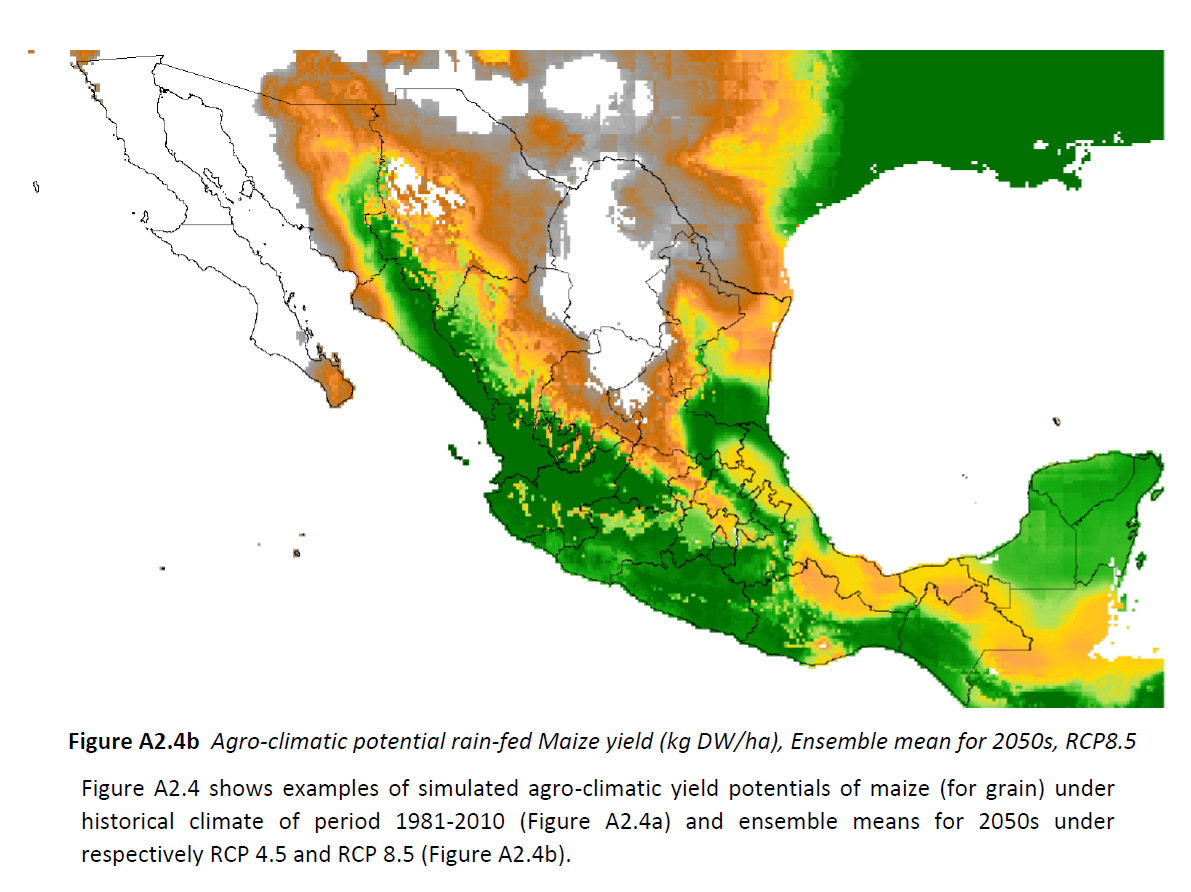
(2) assessment of the potential of Mexico’s main crops and their water requirements under current & future climate scenarios using the AEZ model
(3) pathway analysis for renewable energy transitions using the OSeMOSYS model
Context: As a developing country with moderate levels of emissions, Mexico has made a commitment to redress climate change and move towards sustainable development, including by passing a General Climate Change Law. Following the ratification of the Paris Agreement, the finance & environment ministries requested support to build capacities in the use of modelling tools & integrated assessment methodologies to address interlinkages & trade-offs among goals, priorities, and sectoral policies.
Key insights:
- The agricultural analysis showed the potential impacts climate change on crop suitability, yields, and water requirements across regions, highlighting the increased vulnerability in water-scarce & temperature-sensitive areas.
- The energy analysis showed that Mexico’s power system (currently heavily reliant on natural gas) can transition toward a high share of renewables over the long term thanks to declining technology costs, though with implications for investment needs and system integration.
Tools: Water Evaluation and Planning (WEAP), Agro-Ecological Zones (AEZ), Open Source Energy Modelling Systems (OSeMOSYS).
Stakeholders: The Government of Mexico’s Secretary of Environment & Natural Resources (SEMARNAT), National Institute for Ecology & Climate Change (INECC), Energy Secretariat (SENER), UN DESA, UNDP, ECLAC, and IIASA.