
Lao PDR
When: 2024–2026
Purpose: Achieve Laos’ Green Growth Strategy’s afforestation targets while ensuring food security as per the Agriculture Development Strategy 2025 and respecting the Land Use Master Plan.
What happened: Through an inter-ministerial process, the team designed scenarios to assess how to achieve afforestation targets while promoting climate-resilient agriculture. The on-going, limited cross-sector coordination highlighted the need for integrated planning through frameworks like CLEWs, particularly in countries where agriculture remains central to the economy & livelihoods but pose a development challenge due to rising irrigation demand and land-use change.
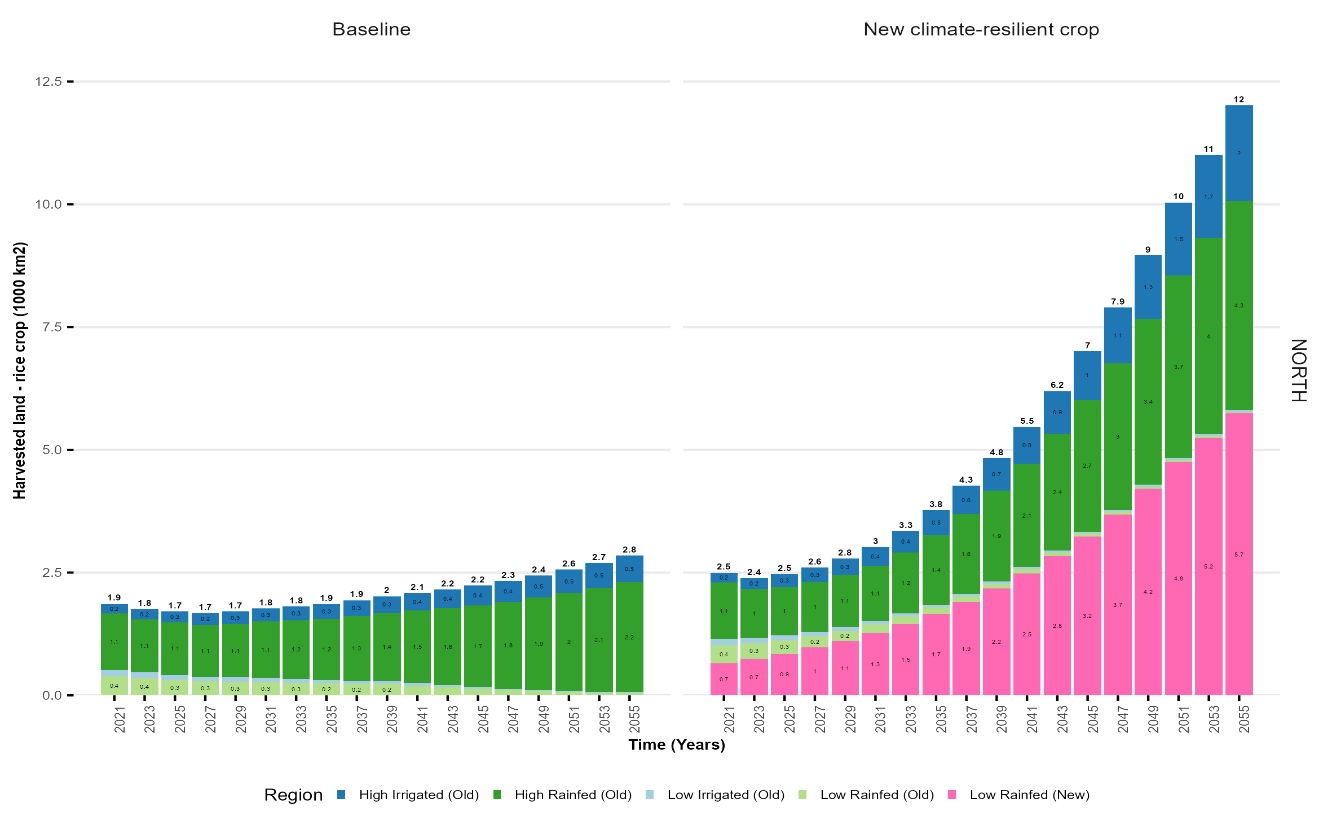
Key insights: In the business-as-usual scenario, expanding forest cover reduced available agricultural land, driving more intensive irrigation and increasing both water use & electricity demand for pumping. In contrast, climate-resilient rainfed agriculture reduced reliance on irrigation & energy use.
- Promote sustainable mechanization of agricultural practices to provide an extra 420,000 tonnes of rice per year while saving 8,000 km2 of land.
- Plan water & energy infrastructure in parallel with afforestation targets because the mechanization will result in a +51% water consumption for irrigation and +34% power consumption by 2055.
- Additional power demand can be met through a minimal increase of solar (+1.2) and wind (+2.5%).
- Support the shift to climate-resilient rainfed rice varieties such as nationally developed thadokkham varieties (TD11), in particular in the north, with a–25% cost.
Tools: OSeMOSYS
Stakeholders: UN DESA, Royal Institute of Technology (KTH), Climate Compatible Growth (CCG), National University of Laos