
Dominican Republic
When: 2023–2025
Purpose: Strengthen alignment between the Long-Term Strategy and the National Development Strategy in response to growing water scarcity driven by inefficient irrigation, agricultural expansion, and climate change.
What happened: A CLEWs assessment examined three scenarios:
(1) business-as-usual, without additional policies or technological improvements(BAU)
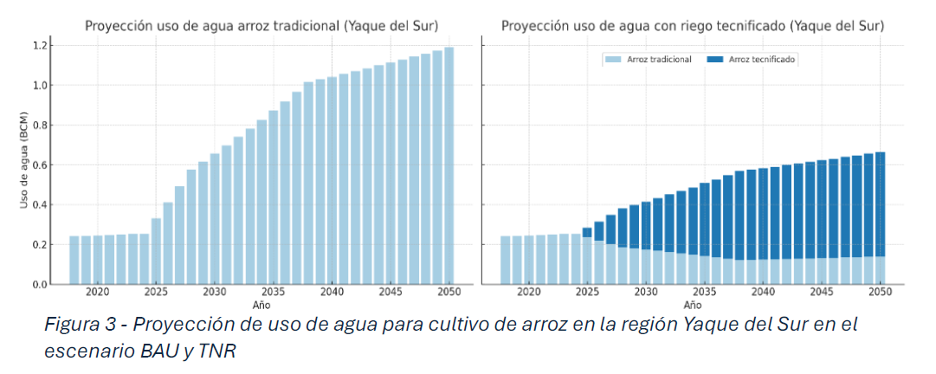
(2) irrigation technification & productivity improvement (TNR)
(3) reduced precipitation based on climate projections (DPP)
Key insights:
• Water stress is the key systemic constraint, with national stress levels around 56% and agriculture consuming 82% of total water use, creating cascading impacts across energy, land, and ecosystems.
• Irrigation inefficiencies amplify cross-sector pressures, but modernization (technification) emerges as a high-impact solution — potentially reducing water use over 40% by 2050 while increasing yields and easing pressure on forests & water resources.
• Water–Land–Productivity dynamics are tightly interlinked, with business-as-usual pathways leading to deforestation & resource degradation, whereas efficiency improvements can stabilize land use and enhance overall system performance.
• Climate change will worsen vulnerabilities through reduced precipitation (15–17%) and declining agricultural yields by 2050. Integrated policy approaches, particularly irrigation modernization, can deliver co-benefits, including lower costs, reduced emissions, improved resilience, and strengthened food production.
Models: OSeMOSYS
Stakeholders: Ministry of Economy, Planning & Development (MEPYD), RCO Dominican Republic, UN DESA, and the Climate Lead Group (CLG).