
Costa Rica
When: 2006–2013 and 2015–2019
Purpose: Formulate and evaluate coherent, evidence-based policies for decarbonization, climate action, water security, land use, and long-term development planning. The CLEWs work builds on earlier LEAP, CGE, and microsimulation support and helps Costa Rica test the system-wide implications of the National Strategic Plan 2050.
What happened: A regionalized CLEW-CR model was developed for six socioeconomic regions, with a 2015-2050 horizon and business-as-usual compared against the National Strategic Plan 2050 pathway. The work was designed to support the country’s “3D” economy vision: decentralized, digitalized, and decarbonized.
Key insights:
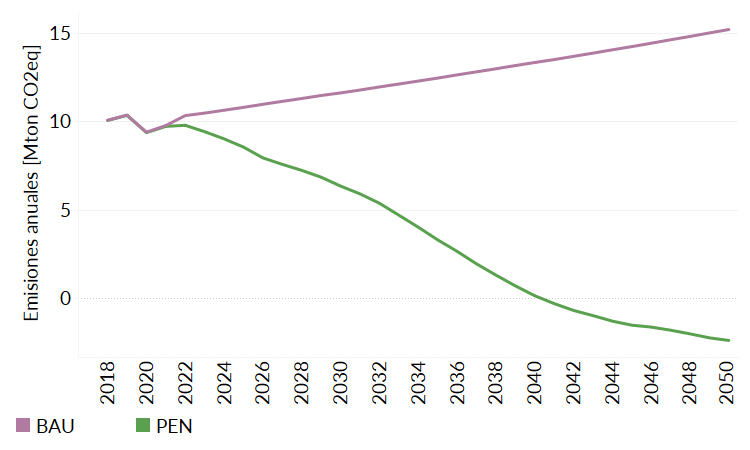
- In modelled sectors, business-as-usual emissions rise to 15.2 MtCO2e by 2050, while the National Strategic Plan pathway reaches -2.4 MtCO2e, a swing of roughly 17.6 MtCO2e.
- Energy and transport emissions fall to 0.382 MtCO2e by 2050 in the plan pathway, compared with 10.3 MtCO2e under business-as-usual.
- Freight transport emissions fall from 4.4 MtCO2e in 2020 to 0.5 MtCO2e by 2050 in the plan pathway; private passenger transport falls from 2.1 MtCO2e to 0.04 MtCO2e.
- Water distribution losses drop from a 52% business-as-usual assumption to 17% by 2035 in the plan pathway, while wastewater emissions in 2050 fall to 0.8641 MtCO2e instead of 1.4561 MtCO2e.
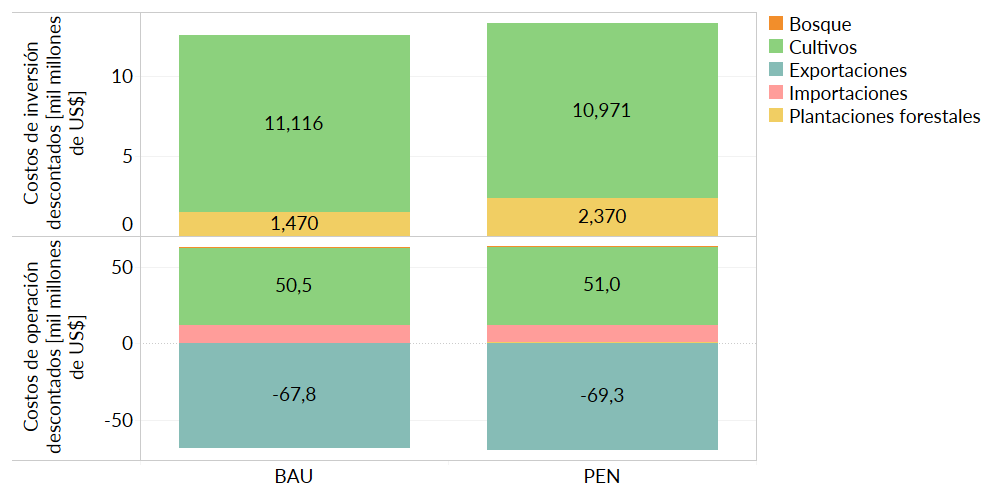
- The plan pathway has lower cumulative investment and operation costs through 2050: about USD 110 billion compared with USD 150 billion under business-as-usual, a benefit of roughly USD 40 billion.
Models: CLEWs, OSeMOSYS, LEAP, CGE-UNDESA, MAMS, MACEPES
Stakeholders: MIDEPLAN, Climate Change Directorate of MINAE, University of Costa Rica EPERLab, Central Bank, Electricity Institute, UN DESA, UNDP, and KTH.