
Bolivia
When: 2006–2013 & 2017–2019
Purpose: Prepare Bolivia’s Intended Nationally Determined Contributions (INDCs) to the Paris Agreement and inform the Energy Development Plan of the Ministry of Hydrocarbons.
Strengthen national analytical capacity on three priority areas:
(1) scaling up ethanol production;
(2) redirecting soybean oil exports toward domestic biodiesel production;
(3) assessing the cross-sectoral impacts of large hydropower projects.
What happened: In the context of Bolivia’s Law No. 1098 (2018), which promotes biofuel production to reduce fuel imports and enhance energy security, a CLEWs model was co-developed through a series of technical workshops & inter-institutional collaboration. The model assessed the implications of increasing bioethanol production to meet up to 25% of national gasoline demand. The analysis focused on scaling up sugarcane production and explored associated cross-sectoral impacts on land use, water resources, and agricultural systems.
Key insights: The modelling showed that achieving ethanol targets through land expansion would require approximately 80,000 additional hectares for sugarcane, potentially leading to deforestation (particularly in the Amazon) and thus revealing a critical trade-off between energy policy & land sustainability. Results highlighted that meeting biofuel targets sustainably depended on improving agricultural productivity & irrigation efficiency rather than expanding cultivated areas.
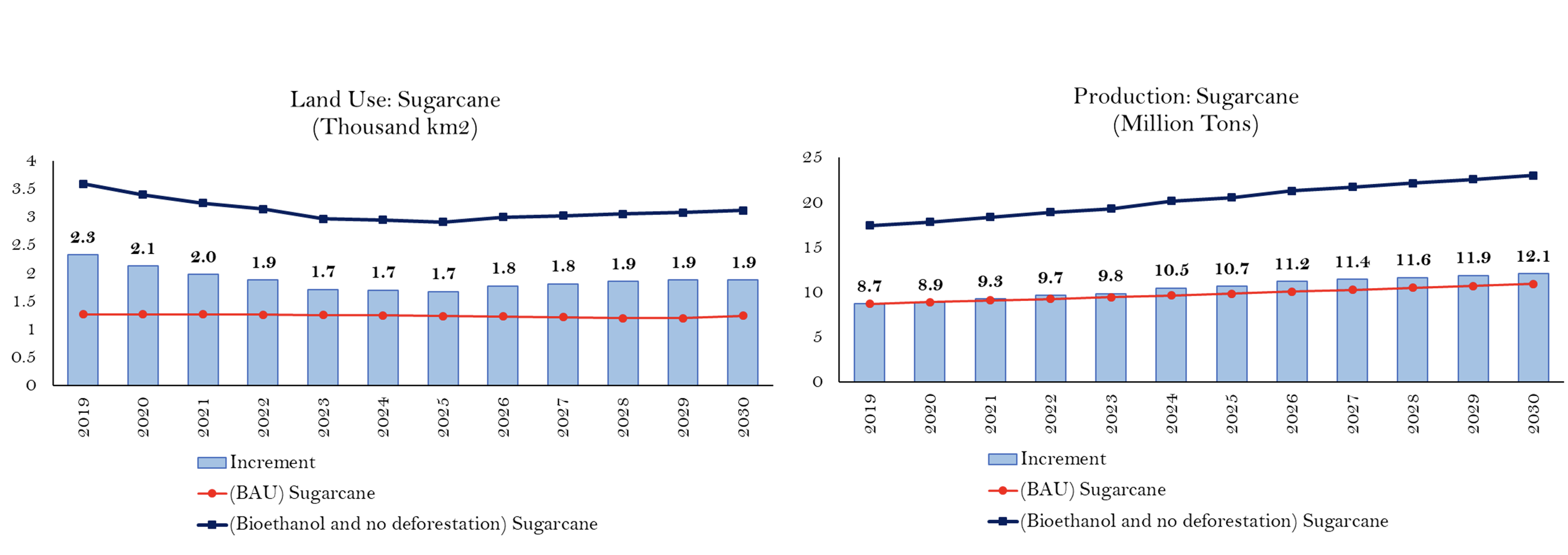
The analysis also underscored the importance of accounting for investment needs, seasonal production dynamics, and the role of by-products (e.g., bagasse) to better capture system-wide impacts.
Models: LEAP, WEAP & OSeMOSYS.
Stakeholders: Government of Bolivia (Unit of Social & Economic Policy Analysis, Ministry of Energy, Ministry of Hydrocarbons, Ministry of Planning & Development, Ministry of Environment & Water) supported by UN DESA, UNDP, KTH-dESA, SEI-US, and IAEA.