
Bhutan
When: 2020–2022
Purpose: Test how Bhutan can preserve carbon-negative development while expanding energy services, improving food self-sufficiency, and managing land & forest constraints.
What happened: The team compared business-as-usual, low-emission energy, food self-sufficiency, irrigation, and climate-sensitivity scenarios.
Key insights:
- Bhutan’s baseline remains strongly carbon-negative: total emissions of 3.814 Gt CO2e are offset by 9.387 Gt CO2e of sequestration, giving net removals of 5.573 Gt CO2e.
- A low-emission pathway reduces cumulative liquid-petroleum fuel demand by 15.36 PJ by 2035, including 10.37 PJ of diesel, 2.85 PJ of LPG, and 2.13 PJ of gasoline.
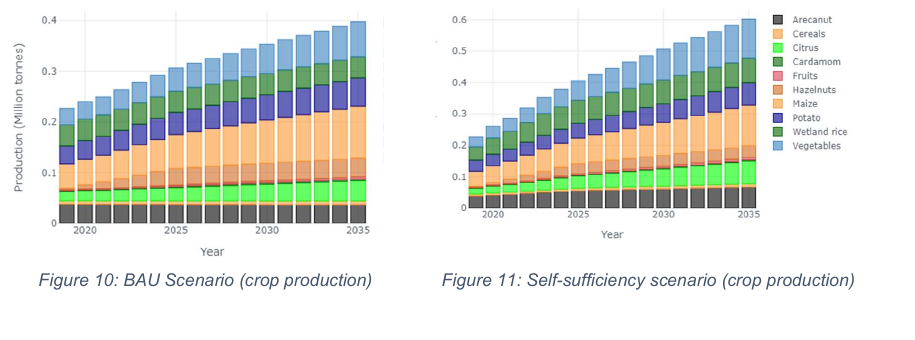
- Food self-sufficiency scenarios raise crop production from 0.2269 Mt in 2019 to 0.6023 Mt by 2035, compared with 0.398 Mt under business-as-usual. It also increases crop land requirements from 63,460 ha in 2019 to 113,440 ha in 2035. Irrigation & climate-yield interactions can lower the 2035 requirement to 102,230 ha.
- The model suggests Bhutan can move toward rice, maize, and vegetable self-sufficiency while staying compatible with the constitutional requirement to keep at least 60% forest cover.
Resources: Bhutan CLEWs report and supporting crop, emissions, and calibration workbooks.
Models: OSeMOSYS
Stakeholders: National Environment Commission Secretariat, National agriculture, industry, forestry, and energy experts, UN DESA, UNDP, KTH.